
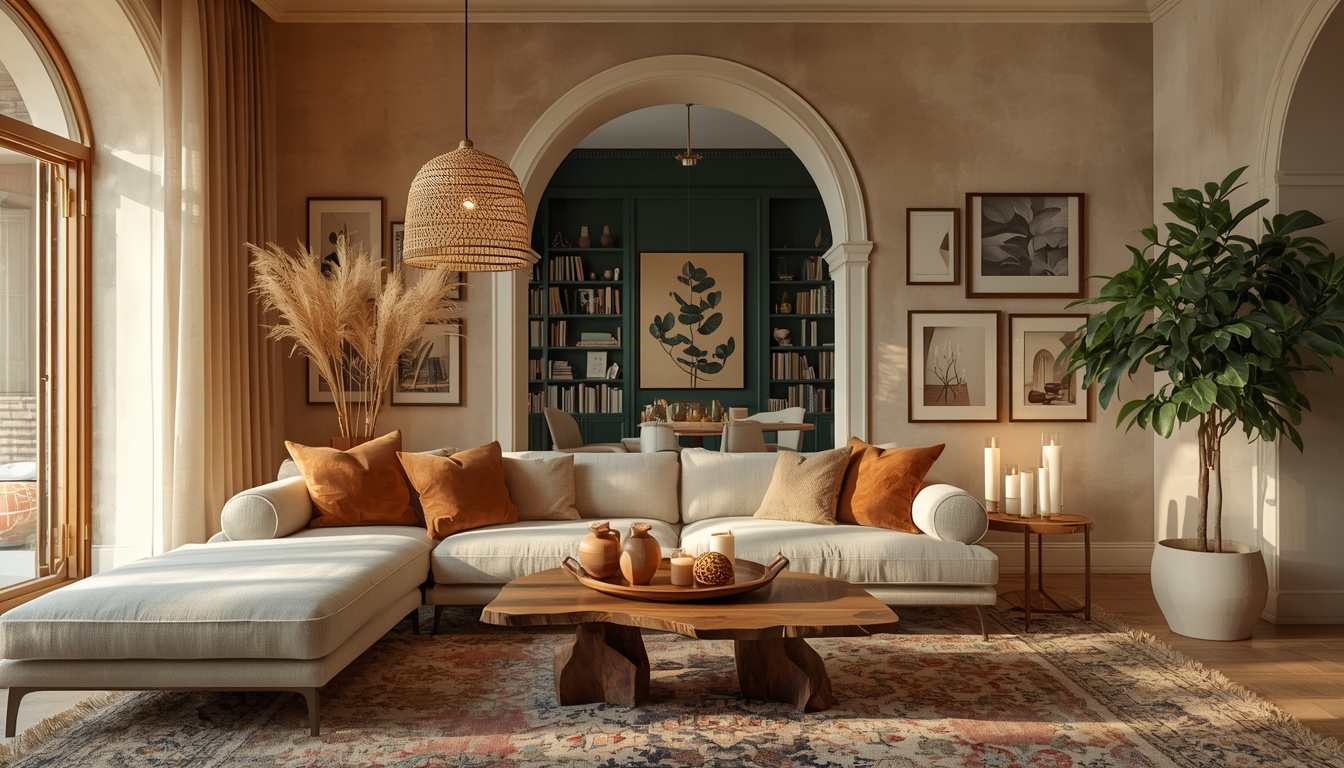
Have you ever walked into a room and felt an instant sense of calm wash over you — like the space itself was giving you a warm hug? That magical feeling doesn’t happen by accident. It’s the result of thoughtful interior design ideas working together in perfect harmony. Whether you’re dreaming of a cozy Scandinavian retreat, a sun-drenched Mediterranean escape, or a sleek modern sanctuary, the way your home looks and feels has a powerful impact on your mood, energy, and overall happiness. A beautifully designed space isn’t just about aesthetics — it’s about creating a life you truly love coming home to.
The good news? You don’t need a massive budget or a professional designer to transform your space. What you do need are the right ideas, a little inspiration, and a clear vision of how you want to feel in your home. This guide is packed with 30 stunning interior design ideas that are not only beautiful and Pinterest-worthy but deeply functional and emotionally resonant. From the art of layering textures to the science of choosing the perfect color palette, every idea here has been chosen to help you create a space that feels uniquely, authentically yours — a home that tells your story.
✨ You’ll absolutely love idea #9 — it’s the one small change that makes a room feel like a luxury hotel suite instantly.
1.The Warm Neutral Color Palette
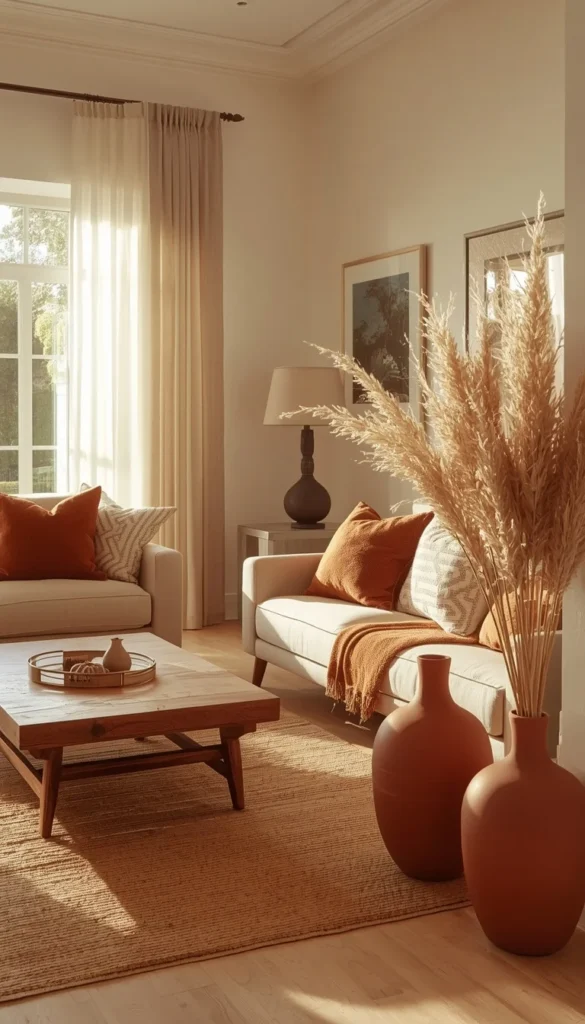
A warm neutral color palette is one of the most powerful interior design ideas you can embrace right now, and it’s trending harder than ever for very good reason. Think creamy off-whites, warm beiges, sandy taupes, and soft greiges — these are colors that feel like a deep exhale. They reflect light beautifully throughout the day, shifting from a soft golden warmth in the morning to a moody, intimate richness in the evenings. Unlike stark white or cold gray, warm neutrals feel inherently human — they wrap a room in comfort without ever feeling boring or bland when layered thoughtfully.
The secret to making a warm neutral palette feel premium rather than plain is all in the layering. Stack different shades of the same warm tone — perhaps a sandstone-painted wall paired with a cream linen sofa, ivory cotton throw pillows, a caramel bouclé armchair, and a faded oatmeal rug. Introduce depth through texture: rough linen beside smooth silk, matte plaster beside glossy ceramics. Add a single earthy accent — a terracotta pot, a rust-toned throw, a burnt sienna lamp base — and your room suddenly tells a complete, beautiful story. This palette never goes out of style, and it makes every other element in the room look more expensive.
2. Layered Textiles & Soft Furnishings
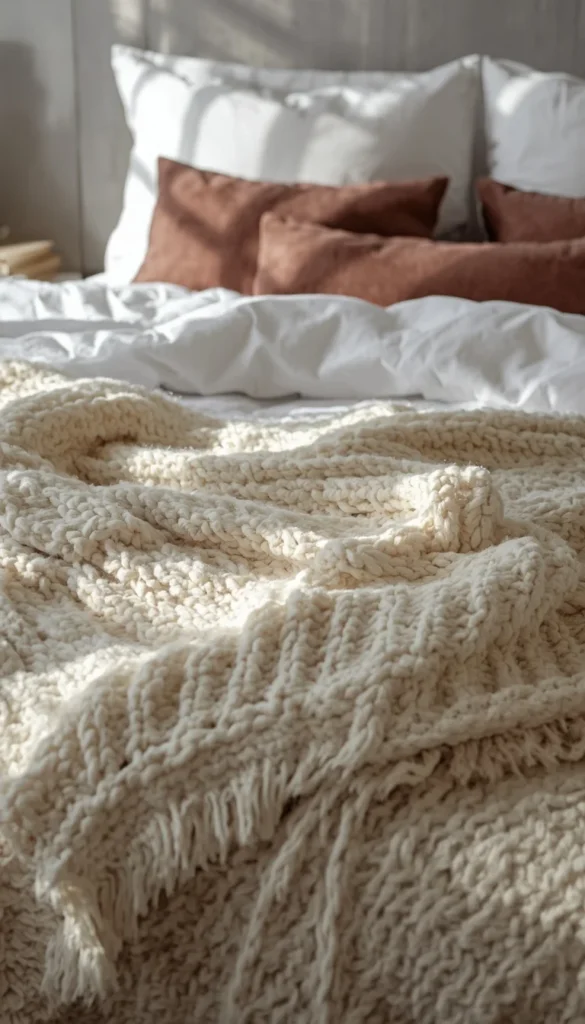
Layered textiles are what separate a beautiful room from a truly irresistible one. This is one of those interior design ideas that is deceptively simple but endlessly transformative — it’s essentially the art of piling together fabrics, throws, and cushions in a way that makes anyone who walks in desperately want to curl up on the sofa and never leave. The key is mixing materials with contrasting textures: a smooth velvet cushion beside a nubby bouclé pillow, a crisp linen duvet topped with a chunky knit throw, a silky decorative blanket draped over a rough jute ottoman. The contrast between these textures creates visual richness that photographs beautifully and feels even better in person.
When layering textiles, think in odd numbers and vary scale deliberately. Three large cushions in complementary tones, two medium throw pillows in contrasting textures, and one lumbar pillow as a focal point creates a composition that feels curated rather than random. Layer rugs for extra depth — a flat-woven kilim underneath a plush wool rug creates incredible visual interest on a hardwood floor. Choose a cohesive but not matching color story: dusty mauve, warm cinnamon, ivory, and deep charcoal all live happily together without looking like a matched set from a catalogue. The result is a space that feels genuinely lived-in, layered with personality, and deeply, completely cozy.
3. Biophilic Design with Indoor Plants
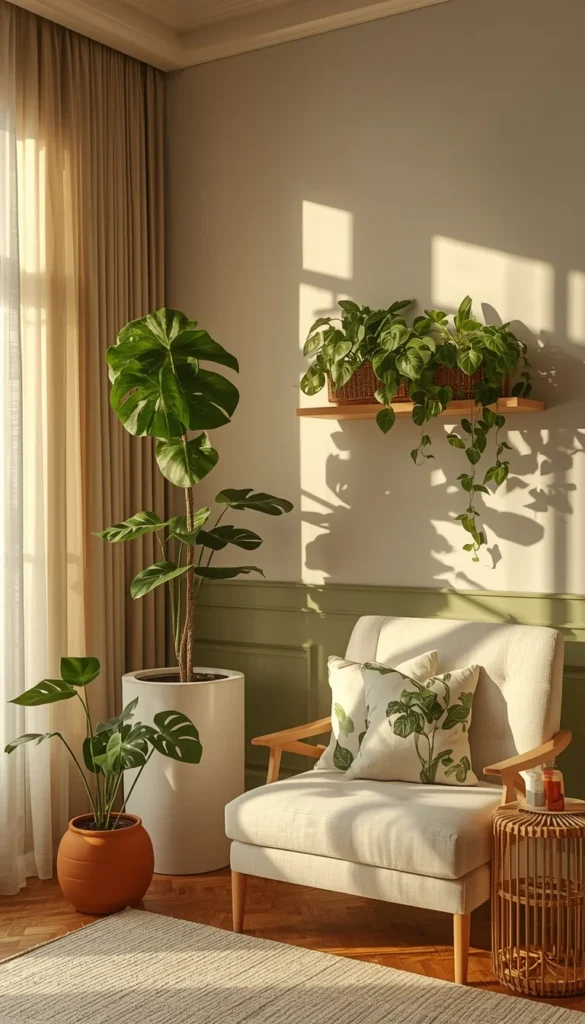
Biophilic interior design — the practice of incorporating natural elements, especially plants, into your home — is one of the most beloved and genuinely transformative interior design ideas of our time. Indoor plants don’t just look gorgeous; research consistently shows they reduce stress, improve air quality, boost creativity, and make us feel more calm and connected. A single large fiddle-leaf fig in a white plaster pot can anchor an entire room, adding vertical drama and a sculptural quality that no piece of furniture can replicate. The contrast of living green against neutral walls creates a freshness and vitality that makes every room feel more alive and more human.
Creating a beautiful indoor plant arrangement is about understanding scale, variety, and placement. Ground your room with one or two large statement plants — a monstera, an olive tree, or a bird of paradise — then build around them with smaller trailing plants on shelves (pothos, string of pearls, ivy) and compact table plants (snake plants, peace lilies, rubber plants) that bring the greenery down to different heights. Choose pots that work as decorative objects in their own right: matte terracotta, hammered brass, glazed stoneware in earthy tones. Cluster plants in odd numbers near natural light sources and let them spill, trail, and grow naturally. Your home will feel like a garden oasis.
4. Statement Lighting as Art
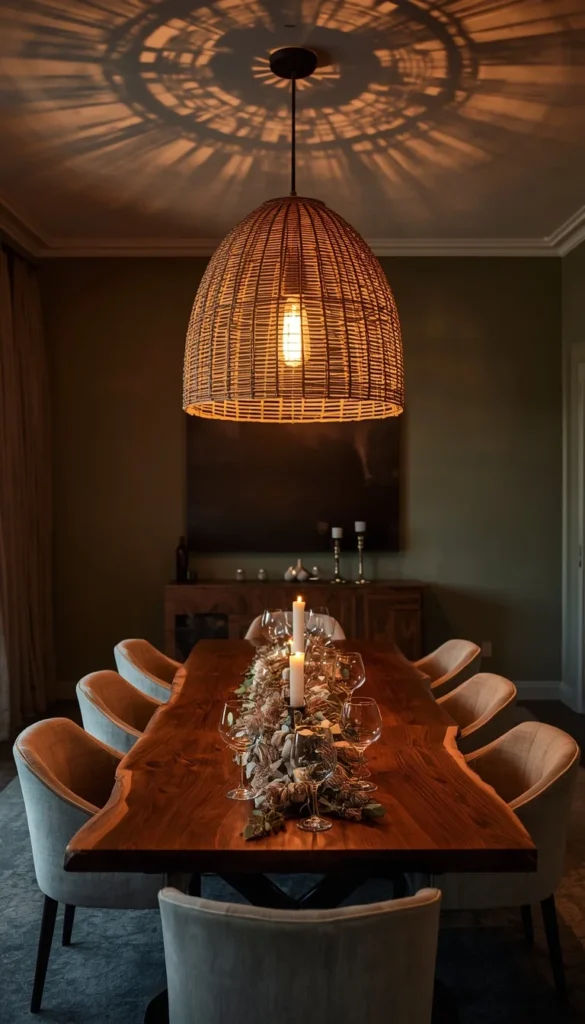
Statement lighting is perhaps the single most underestimated of all interior design ideas, and it is absolutely one of the highest-impact upgrades you can make to any room. The right light fixture isn’t just functional — it’s sculptural, atmospheric, and deeply transformative. Think of a handwoven rattan pendant hanging low over a dining table, casting warm golden light and organic shadow patterns across the ceiling. Or a cluster of blown-glass globes suspended at different heights in a stairwell, catching the light like a constellation. Or an arched brass floor lamp in the corner of a living room, creating a warm reading nook that glows like a golden halo. Lighting sets the emotional temperature of a space before anyone sits down.
The most beautifully lit homes work in layers: ambient overhead lighting provides general illumination, task lighting (table lamps, reading lights, under-cabinet lights) creates pools of warm focused light, and accent lighting (picture lights, LED strips, candles) adds drama and depth. Choose bulbs with a warm color temperature — 2700K to 3000K — to keep your home feeling cozy rather than clinical. Dimmer switches on every fixture are a non-negotiable upgrade: the ability to shift from bright and energizing to low and intimate changes the entire feeling of your home at the flick of a finger. A beautiful pendant or chandelier also works as jewelry for your room — a conversation piece that draws the eye upward and makes the space feel finished, intentional, and alive.
5. The Gallery Wall
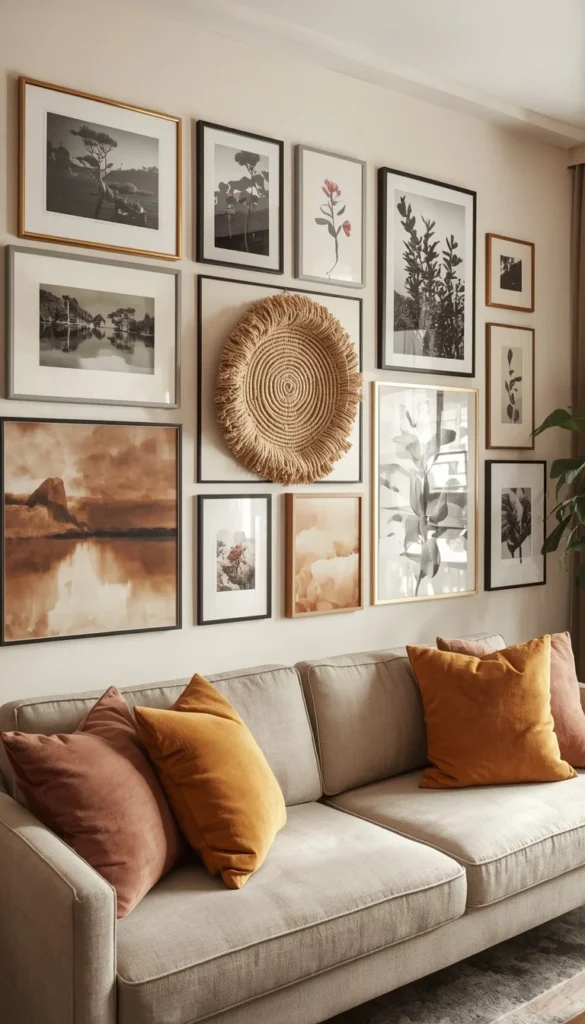
A gallery wall is one of those interior design ideas that feels deeply personal and completely transformative at the same time — it is essentially your life story told through art, photographs, and objects arranged on a wall in a way that is uniquely and irreplaceably yours. The key to creating a gallery wall that looks intentional rather than chaotic is to build it around a cohesive theme: a consistent frame color (all black, all brass, all natural wood), a unifying color palette in the artwork, or a consistent mood (serene botanical prints, moody black-and-white photography, joyful family memories). This visual thread is what prevents the wall from looking like a haphazard collection and gives it the polish of a curated exhibition.
Start by laying your chosen pieces on the floor and experimenting with arrangements before you hammer a single nail. Mix different sizes and orientations — landscape photos, square prints, vertical illustrations — to create visual rhythm. Include non-frame elements for texture and surprise: a woven macramé hanging, a small decorative mirror, a sculptural wall plate, a dried botanical wreath. Leave consistent spacing between each piece — around 3 to 4 inches — for a clean, structured look, or allow them to cluster more loosely for a relaxed salon-style feel. A gallery wall above a sofa, along a staircase, or behind a bed instantly becomes the personality of the entire room, turning a blank wall into something genuinely breathtaking.
✨ Keep scrolling — the next ideas get even better!
6. Natural Wood Accents & Furniture
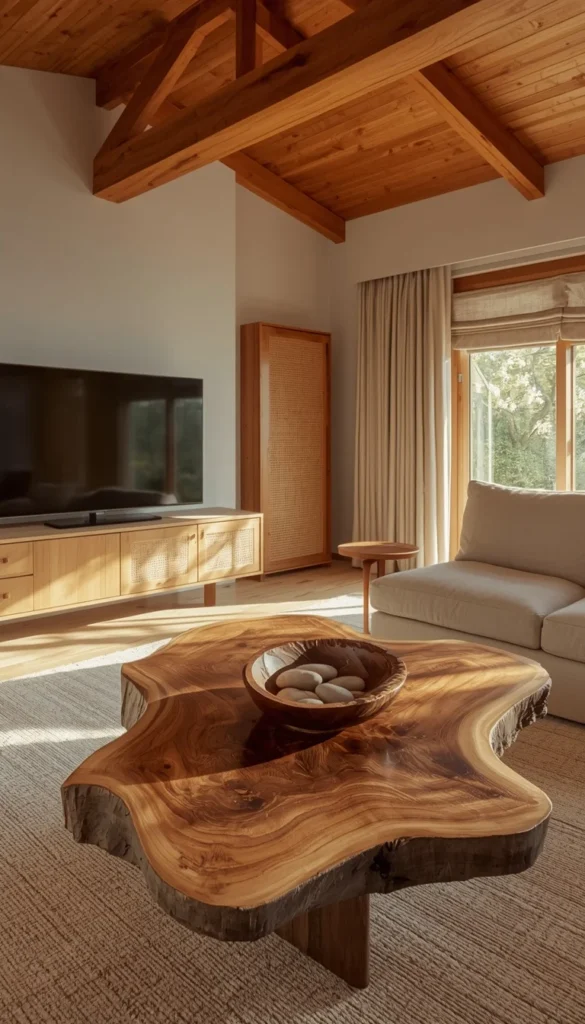
Natural wood is one of those materials that has an almost alchemical ability to warm up any room it enters, and it remains one of the most enduring and beloved of all interior design ideas across every style and aesthetic. Whether it’s a rough-hewn reclaimed wood dining table, a sleek white oak media cabinet, a hand-turned cherry wood lamp base, or a single sculptural piece of driftwood used as a decorative object, wood brings an irreplaceable organic energy that no synthetic material can replicate. The grain patterns, the subtle color variations, the slight imperfections — all of these qualities make wood feel alive, grounded, and genuinely beautiful in a way that gets better with time rather than worse.
When incorporating wood into your interior design, think about variety of tone and finish to avoid a space feeling too heavy or dark. Mix light woods (ash, maple, white oak) with medium tones (walnut, teak) and occasional dark accents (ebony, blackened oak) for a layered, sophisticated look. Pair wood with other natural materials — stone, linen, cotton, leather, rattan — to create a cohesive organic palette that feels collected and curated rather than matchy-matchy. Consider unexpected places to bring in wood: floating shelves, a wooden ladder used as a towel rack in the bathroom, a carved wooden mirror frame, a slatted wood headboard. Every wooden element grounds the room in nature and adds warmth that no paint color or fabric can quite match.
7. Arched Doorways & Curved Furniture
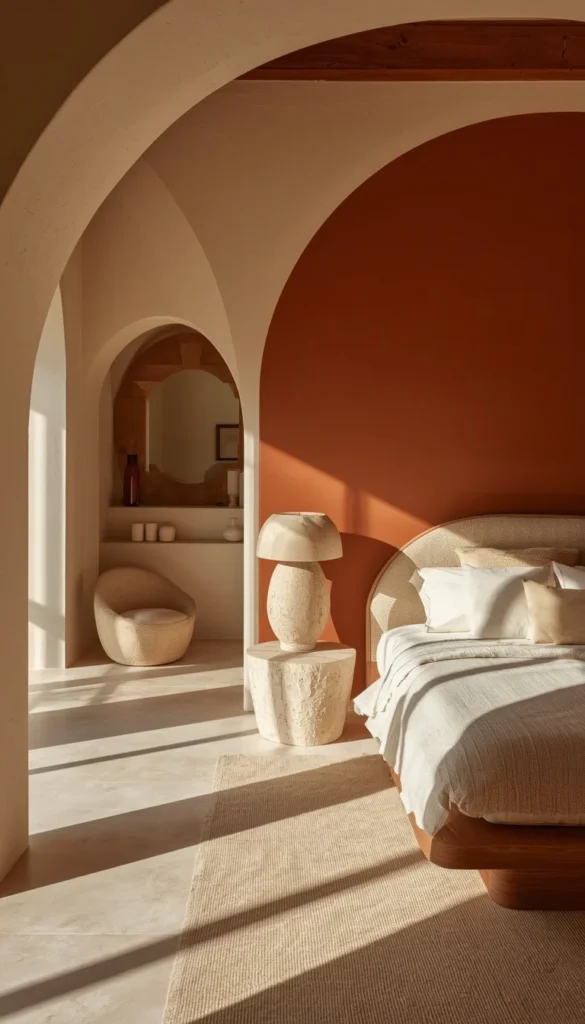
The return of arched doorways, curved sofas, and rounded furniture forms is one of the most exciting and beautiful interior design trends shaping homes right now, and it shows absolutely no signs of slowing down. Curves introduce a softness and fluidity to a room that sharp right angles simply cannot — they feel more organic, more human, more welcoming. An arched doorway transforms a simple opening into a piece of architecture that frames what lies beyond like a painting. A curved sofa invites people to gather and face each other in a way that a rectangular sofa arrangement never quite achieves. Even a simple round mirror above a fireplace or a curved bedside table adds a subtle organic quality that makes the whole room feel more elegant and considered.
Incorporating curves into your home doesn’t require a full renovation, though a rendered plaster arch painted in a warm terracotta or sage green is absolutely worth considering if you have the opportunity. Start with furniture: choose a rounded coffee table over a rectangular one, look for a curved-back accent chair or a crescent-shaped sofa, hang a large circular mirror as a dramatic focal point. Replace square picture frames with oval ones in select spots. Add a kidney-shaped bench at the foot of the bed. Choose a round dining table if space allows — it creates an instantly more intimate dining experience because everyone sits equal distance from everyone else. Curves tell the room to relax, and the people in it listen.
8. The Japandi Aesthetic
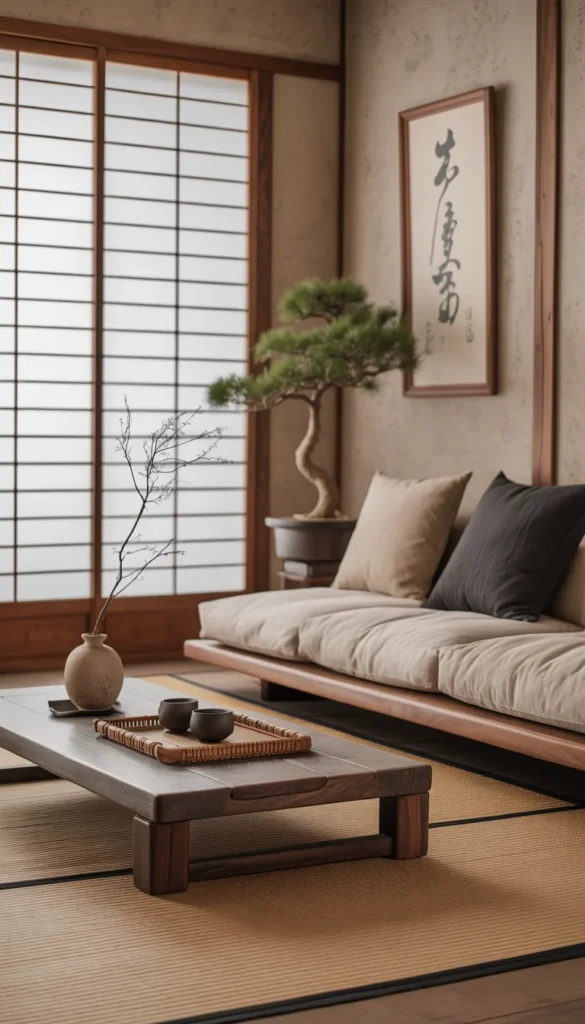
The Japandi aesthetic — a graceful marriage of Japanese minimalism and Scandinavian hygge — has become one of the most coveted interior design ideas of recent years, and once you understand its quiet power, it’s impossible not to fall in love with it. Japandi is built on the philosophy that less is genuinely more, but not in a cold or austere way — rather in the way of a perfectly brewed cup of tea, where every element is intentional and nothing is wasted. The palette is predominantly warm neutrals, soft grays, and earthy tones, with natural materials like wood, bamboo, linen, and stone forming the backbone of every room. There is an emphasis on quality over quantity: a few beautifully made pieces rather than many ordinary ones.
To create a Japandi-inspired room, begin with a ruthless edit — remove anything that doesn’t serve a purpose or bring genuine joy. Then reintroduce pieces slowly and deliberately: a low-profile platform bed in solid walnut, a hand-thrown ceramic bowl on a wooden tray, a single architectural plant in a handmade pot, a woven grass rug on a pale wooden floor. Keep walls clean and calm — a warm white, soft dove gray, or muted sage green. Allow natural light to dominate the mood, using sheer linen curtains or translucent rice paper panels to diffuse it softly. The goal is a room that feels like a breath of fresh mountain air: spare, serene, beautiful, and profoundly restful. The Japandi home is not empty — it’s perfectly full of only what matters.
9. The Luxury Hotel Bedroom Trick
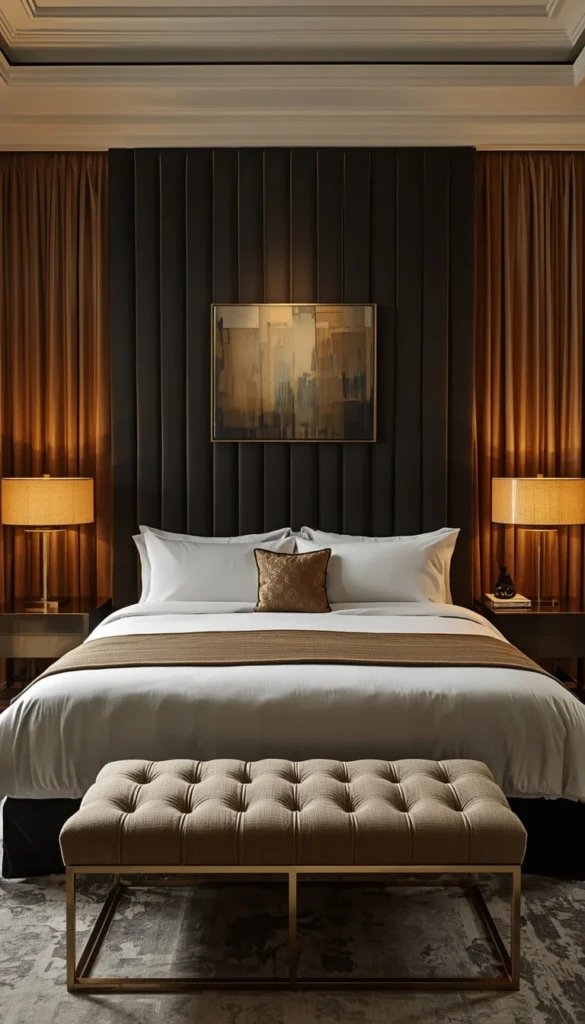
This is the idea so many people scroll past and then can’t stop thinking about — the simple, transformative secret to making your bedroom feel like a five-star luxury hotel suite, and it is far more achievable than you might think. The single most impactful thing you can do is invest in a floor-to-ceiling upholstered headboard — and we mean truly floor-to-ceiling, all the way up to the cornice. This one change creates an instant sense of architectural drama and grandeur that makes even a modest-sized bedroom feel palatial. Pair this with matching bedside tables placed symmetrically on either side, identical lamps at exactly the same height, and a beautifully folded blanket or decorative runner across the foot of the bed, and your room will be completely unrecognizable.
The other non-negotiable element in the hotel bedroom formula is the bedding itself. Layer with purpose: start with a fitted sheet in crisp white cotton percale, add a flat sheet folded neatly back over the duvet, place two sets of pillows — four sleeping pillows in clean white pillowcases and two decorative euro shams behind them — and finish with one or two accent cushions in a complementary fabric (velvet, linen, or silk). Hang floor-length curtains from a rod positioned as close to the ceiling as possible — this tricks the eye into perceiving the room as taller and grander. Add a tufted bench at the foot of the bed. The result is a bedroom that feels intentional, indulgent, and utterly, completely beautiful every single day you wake up in it.
10. Terrazzo & Stone Surface Details
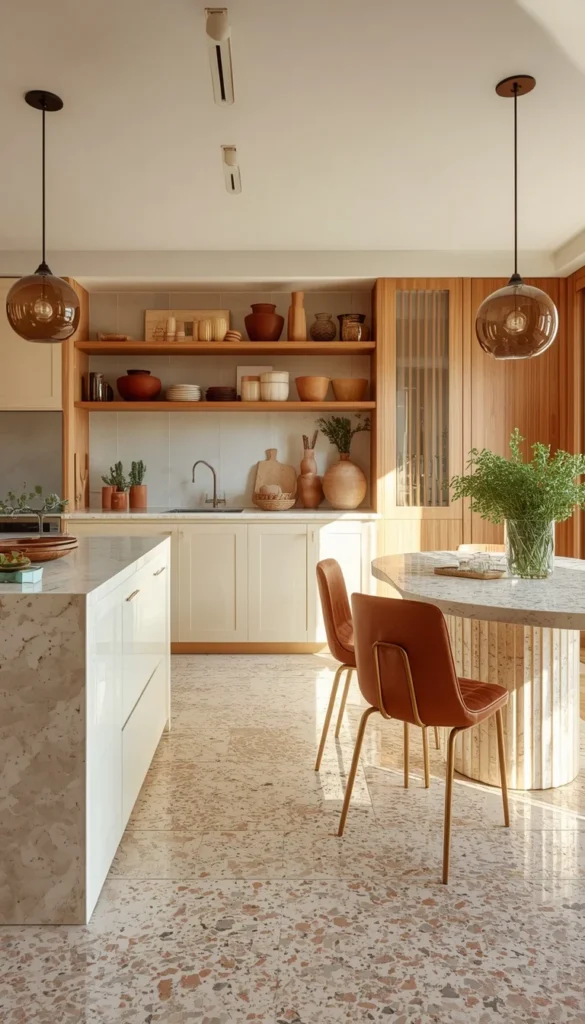
Terrazzo and natural stone surfaces have been making one of the most triumphant comebacks in contemporary interior design, and these materials are now firmly established as some of the most beautiful, versatile, and genuinely sustainable choices you can make in your home. Terrazzo — that gorgeous composite of marble chips, glass fragments, and stone set in concrete or resin — brings a playful yet sophisticated pattern language to floors, countertops, and even furniture. No two terrazzo pieces are ever exactly alike, which means every application is inherently unique. The speckled, confetti-like patterns photograph beautifully and complement almost any color palette, from the most restrained neutral schemes to bolder, more eclectic interiors.
Natural stone — travertine, marble, limestone, slate — brings a depth and gravitas to a room that no manufactured surface can truly replicate. The natural veining of a honed travertine countertop, the cool smoothness of a polished marble bathroom floor, the warm, chalky texture of a raw limestone fireplace surround — these materials carry geological history within them, and that sense of age and permanence makes a room feel rooted and real. Use stone as a statement surface rather than covering every surface: a travertine dining table, a marble kitchen island, a stone-clad bathroom wall. Pair with warm woods, soft linens, and hand-thrown ceramics to balance the stone’s weight with organic softness. The result is a home that feels genuinely, beautifully considered.
✨ Keep scrolling — the next ideas get even better!
11. Earthy Color Blocking
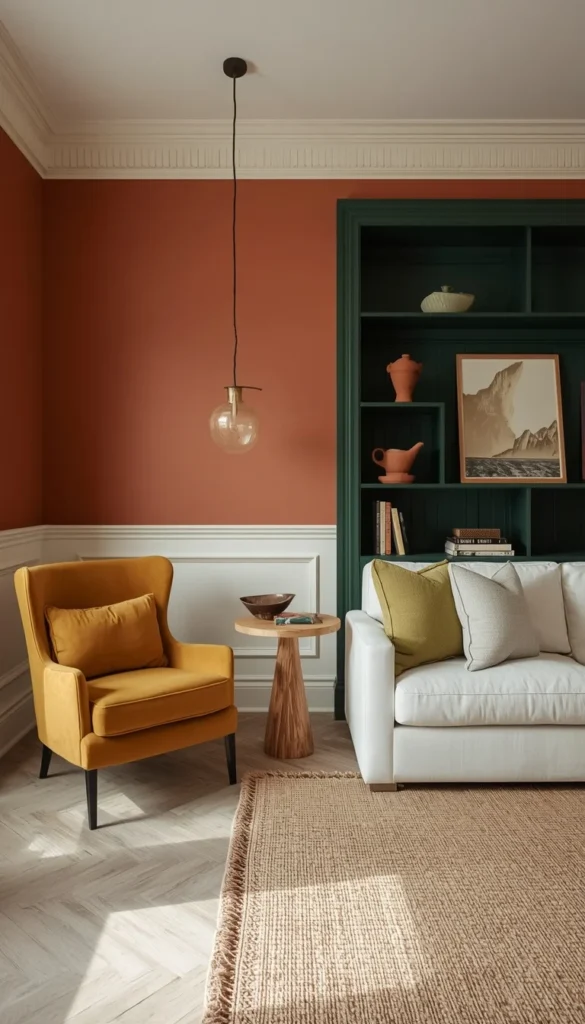
Earthy color blocking is one of the most exciting and confidence-inspiring interior design ideas gaining serious momentum right now, offering a way to use bold, saturated color in your home that feels grounded, sophisticated, and deeply intentional rather than overwhelming or trendy-in-the-wrong-way. Unlike the bright primary colors of mid-century color blocking, earthy color blocking draws from the natural world: warm terracotta, deep forest green, rich ochre, dusty mauve, burnt sienna, faded indigo — colors that feel like they belong to the land. These tones harmonize with each other naturally, which means even bold combinations like terracotta and forest green or ochre and deep plum feel cohesive rather than jarring when put together in the same space.
The simplest way to try earthy color blocking is with paint. Choose a deep, moody terracotta and paint the lower third of your living room wall, stopping at a natural break point like a dado rail or a shelf line, allowing a warm cream or off-white to dominate above. Paint a single built-in bookshelf or alcove in a rich forest green or deep cobalt to create a jewel-box effect that makes everything displayed within it look twice as beautiful. For a bolder approach, paint two adjacent walls in complementary earthy tones and allow them to meet at the corner without any break — this creates a surprisingly sophisticated effect that looks far more expensive than it is. Earthy color blocking is the most affordable, highest-impact interior design upgrade you can make with a tin of paint and a weekend afternoon.
12. Open Shelving as Living Displays
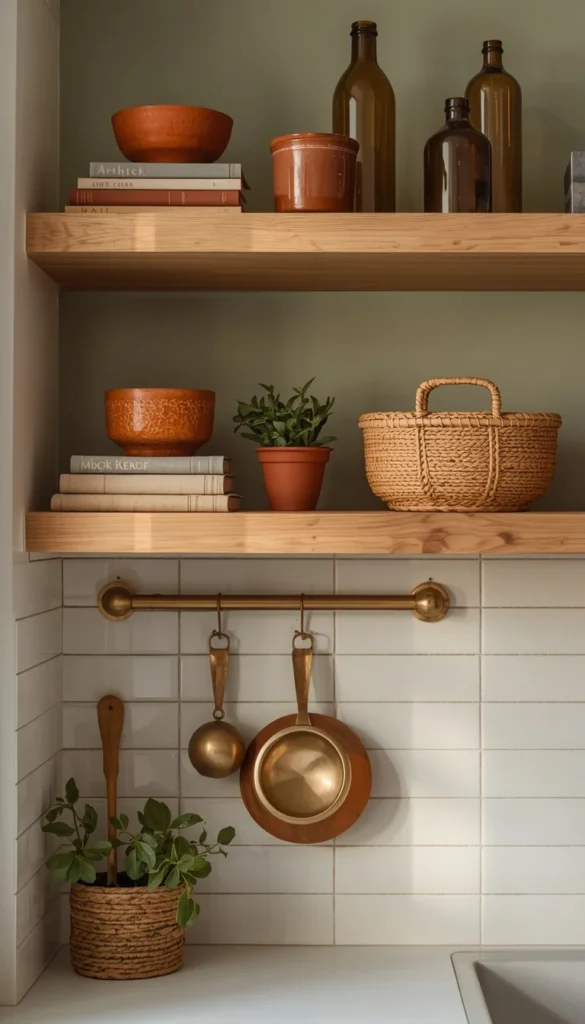
Open shelving as a display strategy is one of those interior design ideas that simultaneously solves a storage problem and creates a stunning visual feature — and when done well, styled open shelves can be more beautiful than any artwork you could hang on the wall. The key distinction between beautiful open shelving and chaotic open shelving lies entirely in curation and restraint. Beautiful shelves tell a story through a carefully chosen collection of objects that share a color palette, a material family, or a personal significance. Think a row of hand-thrown ceramic vessels in warm clay tones, stacked linen-bound books, a sculptural piece of driftwood, three glass bottles of different heights catching the light — together, these objects create a composition that is deeply personal and genuinely arresting.
When styling open shelves, work with the rule of three: group objects in clusters of three at different heights and scales — one tall, one medium, one small — with breathing room between each cluster. Vary between flat objects (books stacked horizontally), vertical objects (vases, candles), and textural objects (baskets, plants, ceramics) to create visual movement across the shelf. Leave at least 30 percent of the shelf empty — negative space is as important as the objects themselves, giving the eye places to rest. In kitchens, mix purely decorative objects with beautiful everyday items: a wooden salt cellar, a ceramic olive oil bottle, a string of dried chilis — things that are useful but beautiful enough to be displayed with pride. Open shelving done this way doesn’t just store things; it celebrates them.
13. The Reading Nook Sanctuary
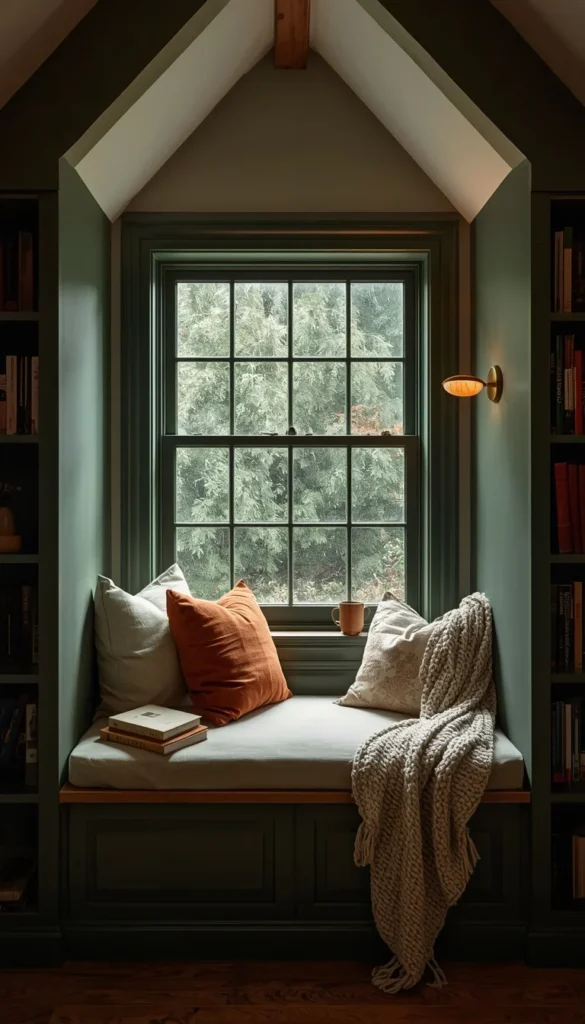
A dedicated reading nook might be the single most soul-nourishing of all interior design ideas — a small, intentional sanctuary carved out of your home that belongs entirely to you and your books and the quiet pleasure of sitting still. The most magical reading nooks feel discovered rather than designed: tucked under a staircase, nestled into a deep dormer window, built into an alcove beside a fireplace, or created in the corner of a bedroom with a simple L-shaped bench and curtains that can be drawn closed against the world. The physical act of stepping into a reading nook creates an almost immediate psychological shift — the cozy proportions tell your nervous system that it is safe to slow down, to breathe, to be present in a way that sprawling rooms rarely do.
Creating a beautiful reading nook requires just a few essential elements done well: a comfortable, well-cushioned seat with back support (a window bench at least 24 inches deep is ideal, but even a generous armchair in a curtained corner works beautifully), good adjustable task lighting at the right height and angle to read without strain, and storage for books within easy reach — whether built-in bookshelves flanking the seat, floating shelves above, or a small side table that can hold a stack of current reads. Layer with tactile comfort: a chunky knit throw, a sheepskin rug underfoot, cushions in varying softness. Add a candle or a small plant for sensory pleasure. Your reading nook should feel like the warmest, most private room in the house — even if it’s only 4 feet wide
14. Vintage & Antique Mixing
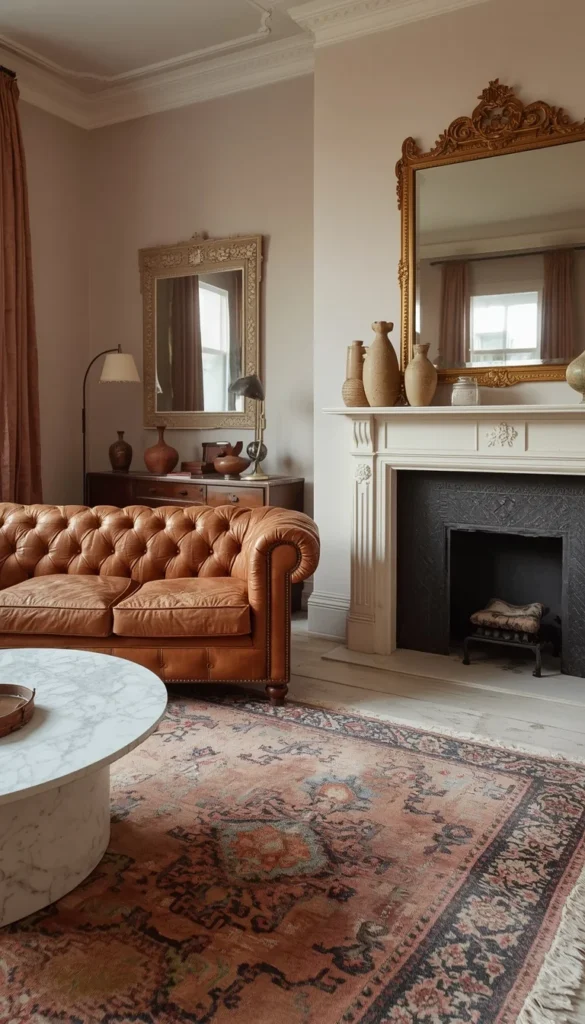
Mixing vintage and antique pieces with contemporary furniture is one of the most creatively satisfying and aesthetically distinctive interior design ideas available to anyone at any budget level — because unlike trending pieces, vintage items are always one-of-a-kind, always full of character, and always priced in ways that pure new furniture never is. The design philosophy here is that rooms with a mix of different periods and provenance feel genuinely lived-in and personally curated rather than showroom-perfect. A worn leather Chesterfield beside a sleek marble coffee table, a faded Turkish kilim rug beneath a contemporary linen sofa, a Victorian gilded mirror above a minimalist plaster fireplace — these juxtapositions create a creative tension that makes a room feel endlessly interesting and deeply real.
The secret to mixing vintage and contemporary successfully lies in identifying the visual thread that ties the pieces together — it might be a shared color palette, a complementary material family (all warm metals, all natural woods), or a shared mood (all pieces that feel aged and storied). Shopping for vintage pieces requires patience and an open, curious eye: estate sales, antique fairs, charity shops, and online marketplaces are all treasure troves. Look for pieces with great bones and beautiful proportions even if the upholstery or finish needs attention — a re-covered vintage armchair in a beautiful contemporary fabric is often more stunning than anything you could buy new. Vintage mixing gives your home the most precious quality in interior design: the feeling of a space that has evolved organically over time and been loved thoroughly along the way.
15. The Statement Fireplace
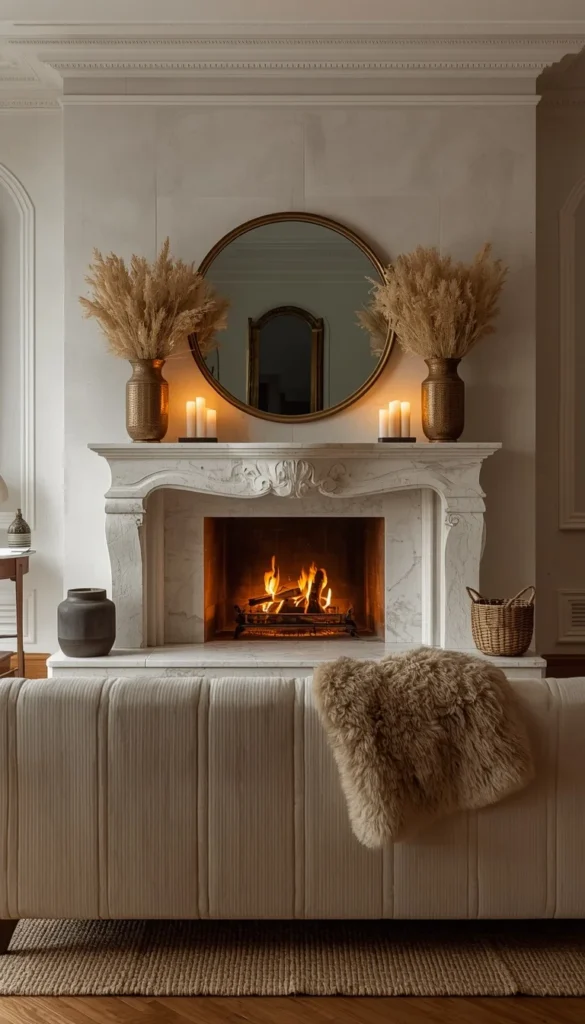
A beautiful fireplace is arguably the most emotionally powerful element in any room — it is the architectural hearth around which human beings have gathered for warmth, conversation, and comfort for all of recorded history, and a room with a fireplace always feels more complete, more intimate, and more fundamentally home-like than one without. Whether you are fortunate enough to have an original Victorian or Georgian fireplace to restore and highlight, or you are creating a contemporary statement fireplace from scratch, the design principle is the same: treat the fireplace as the soul of the room and let every other element in the space orient toward it. The fireplace earns its position as the focal point — let it own that role completely.
Contemporary fireplace design has never been more exciting or more beautiful. Limewash plaster surrounds in warm cream or soft sage give a raw, organic architectural quality that feels both ancient and entirely modern. Fluted plaster details add elegance and texture. Oversized stone mantels in raw travertine or honed limestone create a sense of grandeur. For those without a real fireplace, a well-designed ethanol or electric fireplace set within a custom-built surround is a completely viable and beautiful alternative — the flickering light it provides transforms the atmosphere of a room just as effectively as the real thing. Style the mantelpiece as carefully as you would a coffee table: one large mirror or artwork, flanked by organic elements of different heights — dried botanicals, sculptural ceramics, a candle cluster — for a mantlepiece that is as beautiful cold as it is when lit.
✨ Keep scrolling — the next ideas get even better!
16. Limewash & Textured Wall Finishes
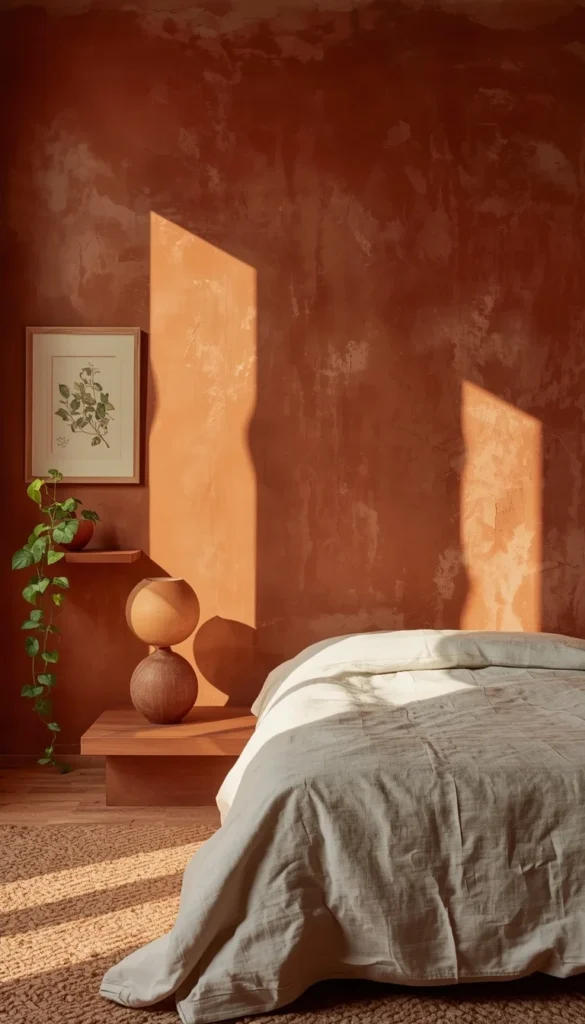
Textured wall finishes — limewash paint, Venetian plaster, Roman clay, raw plaster — are one of the most impactful and increasingly sought-after interior design ideas right now, and they represent a powerful move away from the flat, uniform paint surfaces that dominated interiors for the past two decades. Limewash paint, in particular, has captured the design world’s imagination for its extraordinary quality of looking completely different as the light in a room changes throughout the day. Applied in multiple thin layers with a broad brush, it creates a naturally mottled, antiqued surface that seems to have depth and warmth beyond the wall itself — as if the color lives within the plaster rather than on top of it. It is simultaneously ancient and entirely contemporary.
The most popular limewash and textured plaster colors right now are warm, earthy, and deeply beautiful: burnt sienna, aged terracotta, dusty sage, faded ochre, and chalky off-white. These tones work magnificently in bedrooms and living rooms where the play of natural and artificial light across the texture is most visible. The application technique matters enormously — apply in overlapping, slightly irregular strokes and allow some of the base coat to show through for maximum depth and movement. Pair textured walls with simple, clean-lined furniture to let the wall be the star, and choose fabrics in complementary natural tones. A limewash or textured plaster wall is one of those deeply satisfying design investments that guests will notice and comment on every single time they visit.
17. Sustainable & Handmade Decor
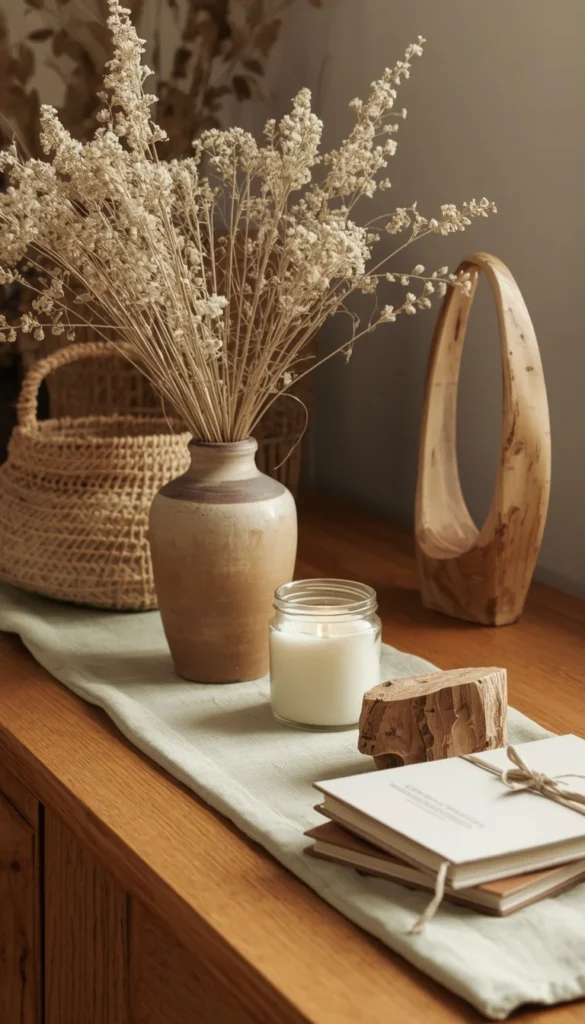
Sustainable, handmade, and artisan-made decor is one of the most meaningful and beautiful interior design ideas gaining powerful momentum among conscious homemakers — because it represents a fundamental shift in how we think about the objects we bring into our homes. A handmade piece carries within it the story of the maker: the hands that threw the clay, the loom the textile was woven on, the forest the wood came from. These objects have a warmth, an irregularity, and an authenticity that mass-produced items simply cannot replicate, and that quality translates visually and physically into a room that feels genuinely alive rather than assembled from a catalogue. Choosing handmade is also an act of integrity — supporting artisans, reducing environmental impact, and investing in pieces built to last generations rather than seasons.
Building a home around sustainable and handmade decor is less about sacrifice and more about intentionality. Seek out local potters and ceramicists for beautiful hand-thrown bowls, vases, and plates that bring organic form and one-of-a-kind character to your shelves and tables. Look for hand-woven textiles — baskets, throws, rugs — from traditional craft communities around the world. Choose furniture made from sustainably sourced solid wood that will be passed down rather than discarded. Burn natural soy or beeswax candles poured by hand in recycled glass vessels. Display dried botanicals gathered from your own garden or local hedgerows. These small, thoughtful choices accumulate into a home that has genuine soul — a space that feels not just beautiful but deeply, meaningfully good.
18. Maximalist Botanical Style
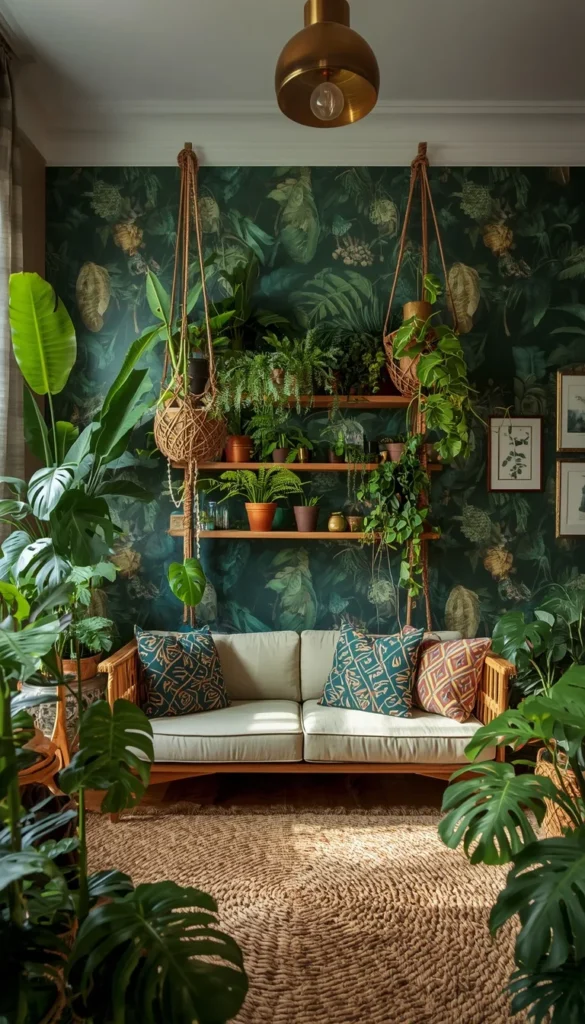
Maximalist botanical style takes the principle of biophilic design and amplifies it to its most joyful, lush, and exuberant expression — this is interior design for the unapologetic plant lover, the person who believes there is genuinely no such thing as too many plants and that a room can never have too much green. The maximalist botanical aesthetic is characterized by layered plant life at every height and scale, botanical wallpapers and prints, natural rattan and wicker furniture, earthy terracotta and handmade ceramics, and a general atmosphere of verdant, living abundance that makes the outside feel like it has triumphantly moved in. Rooms styled in this way have an unmistakable energy — they feel alive, oxygen-rich, creative, and deeply, infectiously happy.
Creating a maximalist botanical interior requires strategic layering to avoid genuine chaos. Start with the floor level: large statement plants in beautiful pots create the backbone. Move to mid-height surfaces: shelves, consoles, windowsills, and side tables populated with medium plants in varied pot styles. Rise to ceiling height with hanging planters and trailing vines on mounted hooks. On the walls, choose a botanical wallpaper — dark-backgrounded designs in deep forest green, navy, or black with gold botanical illustrations feel particularly dramatic and beautiful — on a single accent wall, letting the plants in the room echo and extend the wall’s imagery into three dimensions. Layer botanical print cushions, linen-covered journals, and pressed flower artwork into the mix. The effect is a room that feels less designed and more grown — and utterly, completely magnificent.
19. Cozy Outdoor-Indoor Living
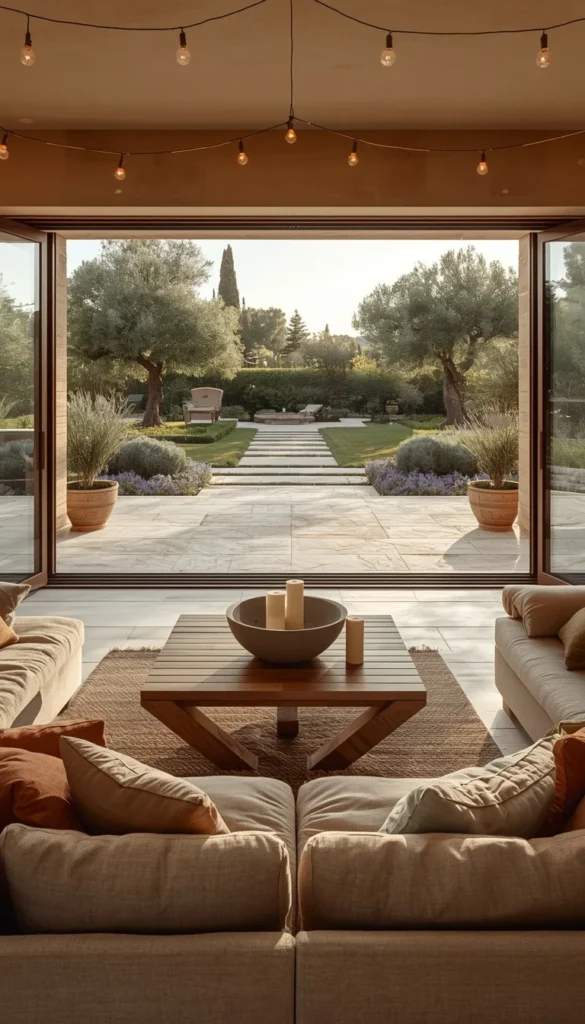
The concept of seamless indoor-outdoor living is one of the most aspirational and lifestyle-transforming interior design ideas you can invest in, representing a fundamental reimagining of how we relate to our homes and the natural world beyond them. When the boundary between inside and outside dissolves — through large folding glass doors, consistent flooring that continues from the living room to the terrace, or a thoughtfully designed transition zone that blurs the division — something remarkable happens to how a home feels. Spaces seem larger, light becomes more generous, air more fresh, and the simple act of sitting in your living room becomes a richer, more grounded sensory experience because you are, in some meaningful way, always slightly outside too.
Creating beautiful indoor-outdoor living doesn’t necessarily require structural renovation. Even without bi-folding doors, you can create the feeling of a connected outdoor living space by furnishing your garden, balcony, or terrace with the same care and intention you would an indoor room: a weather-resistant sectional sofa with quality outdoor cushions, a low coffee table, a kilim-style outdoor rug, good outdoor lighting (string lights, solar lanterns, pillar candles in storm glasses), and plants that bridge the gap between garden and interior. Choose furniture in materials and tones that echo your interior — natural teak, stone, linen — to create visual continuity. String outdoor fairy lights overhead, add a fire pit or outdoor heater for cooler evenings, and you will find yourself outside more than inside, exactly as nature intended.
20. The Dark, Moody Room
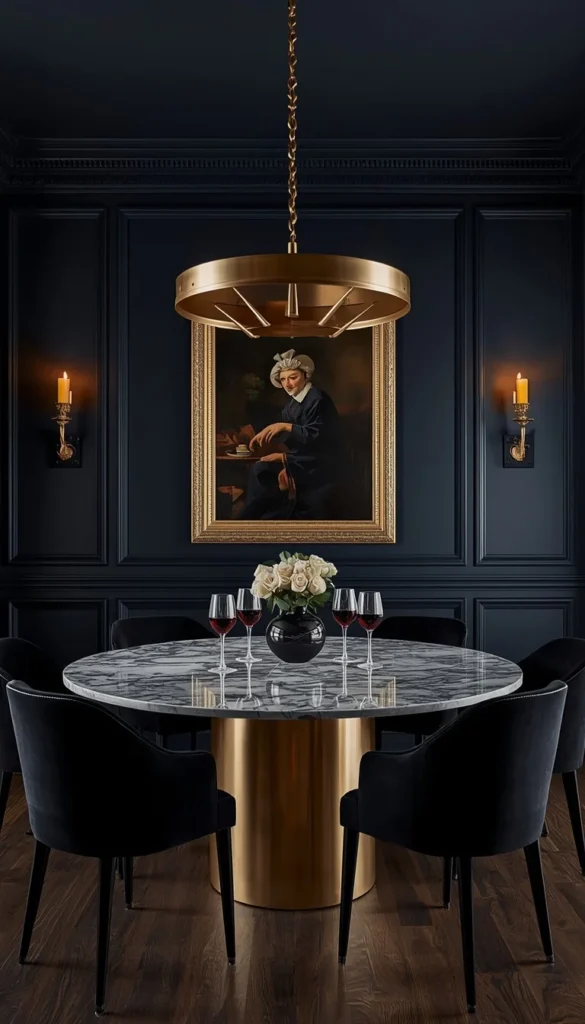
The dark, moody room is one of the most dramatically beautiful and surprisingly liveable of all contemporary interior design ideas — and it remains deeply misunderstood by the many people who assume that dark rooms must feel oppressive, small, or cave-like. The truth is precisely the opposite: a room painted in a deep, rich, saturated tone — inky navy, forest green, charcoal, aubergine, midnight blue — becomes more intimate, more enveloping, and more atmospheric than any light room could ever be. Dark walls make art pop and glow as if lit from within. They make warm light sources — candles, incandescent lamps, firelight — look extraordinarily beautiful against them. They make the furniture and objects in a room read with more clarity and definition. A dark room at night, lit by candlelight and a warm lamp, is one of the most beautiful interior design experiences that exists.
The keys to making a dark room feel luxurious rather than oppressive are reflective surfaces and warm light. In a dark room, mirrors become essential: a large gilded mirror opposite a window doubles the available light and creates depth. Brass, gold, and copper metallic accents — table lamp bases, picture frames, door hardware, candelabras — catch the light against dark walls with exceptional beauty. Choose upholstery and textiles in rich, jewel-toned velvets and silks — deep ruby, emerald, burnished gold — that feel opulent against the dark backdrop. Avoid overhead fluorescent-style lighting entirely: opt for low lamps, wall sconces, and clustered candles for a light quality that makes the dark walls feel magical. Paint the ceiling the same dark color as the walls to create a complete, enveloping cocoon — this is the move that takes a dark room from interesting to truly unforgettable.
✨ Keep scrolling — the next ideas get even better!
21. Rattan, Cane & Wicker Details
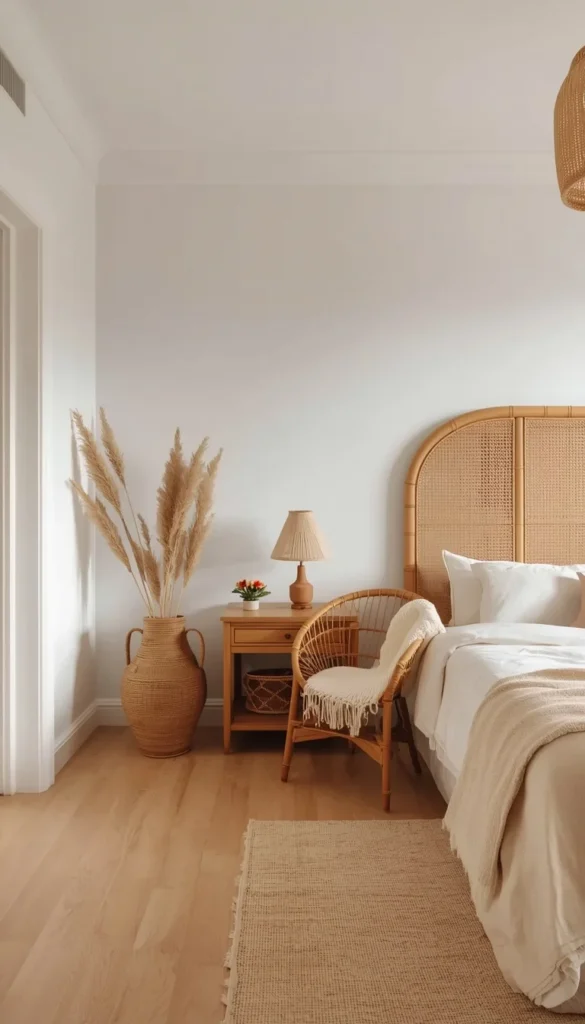
Rattan, cane, and wicker have experienced a remarkable and thoroughly deserved renaissance in contemporary interior design — these are materials that have been woven by human hands for thousands of years across dozens of cultures, and their current design moment feels less like a trend and more like a homecoming. The warm, honey-golden tones of natural rattan and cane bring an organic lightness to a room that feels simultaneously relaxed and refined. A rattan headboard adds architectural texture and warmth to a bedroom without the visual weight of an upholstered one. Cane-fronted cabinet doors bring a handcrafted quality and visual permeability to a sideboard or wardrobe. A woven rattan pendant light casts the most extraordinary dappled light patterns across walls and ceilings at night.
Incorporating rattan and cane works beautifully in almost any interior aesthetic — from coastal boho to modern Japandi to warm eclectic — because its neutral, natural tones harmonize with virtually every color palette. The key is choosing pieces of genuine quality: solid rattan frames and tight, even weave patterns will outlast the trend cycle and age beautifully, developing a slightly darker, richer patina over time that only increases their charm. Mix rattan with other natural materials — linen, jute, wood, cotton, terracotta — for a room that feels deeply organic and coherent. Place a large rattan floor vase filled with dried botanicals in an empty corner and it will instantly become the most commented-on element in the room: effortlessly beautiful, completely simple, and genuinely special.
22. The Spa-Inspired Bathroom
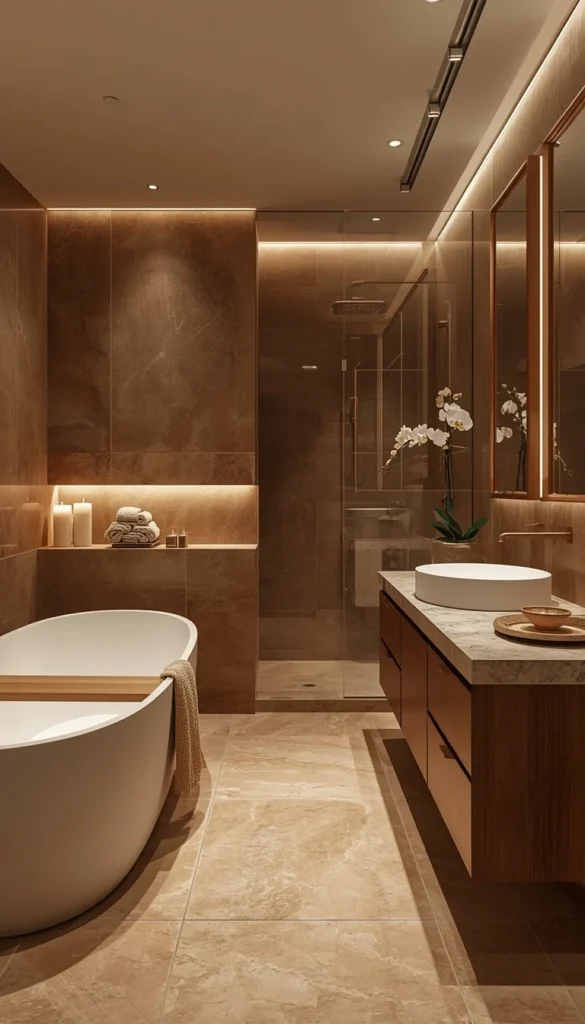
A spa-inspired bathroom is one of the most personally impactful interior design ideas you can invest in, because unlike almost any other room in your home, the bathroom is where you begin and end every single day — and the quality of that daily ritual has a measurable effect on your mood, your sense of self-care, and your overall sense of wellbeing. The spa bathroom aesthetic is built on three key pillars: natural stone or stone-effect surfaces that create a sense of grounded, earthy luxury; warm, layered lighting that allows you to shift between bright and functional in the morning and soft and atmospheric in the evening; and a carefully curated selection of beautiful objects that transform practical necessities into sensory pleasures.
Transforming a bathroom into a spa sanctuary doesn’t require a complete renovation — though a freestanding bathtub and floor-to-ceiling stone tiles are certainly the dream destination. Even in a standard bathroom, swapping out chrome fixtures for brushed brass or matte black hardware makes a dramatic difference in elegance. Install dimmer switches on all lighting and add a separate warm wall sconce beside the mirror for evening use. Replace plastic storage with beautiful alternatives: a wooden tray to corral bottles and soaps, a ceramic dish for jewelry, a waffle-weave towel warmed on a heated rail. Introduce a single living plant (peace lilies and ferns thrive in bathroom humidity) and a reed diffuser or natural soy candle. These small, intentional upgrades accumulate into a bathroom experience that genuinely feels like a daily retreat.
23. The Scandi-Luxe Kitchen
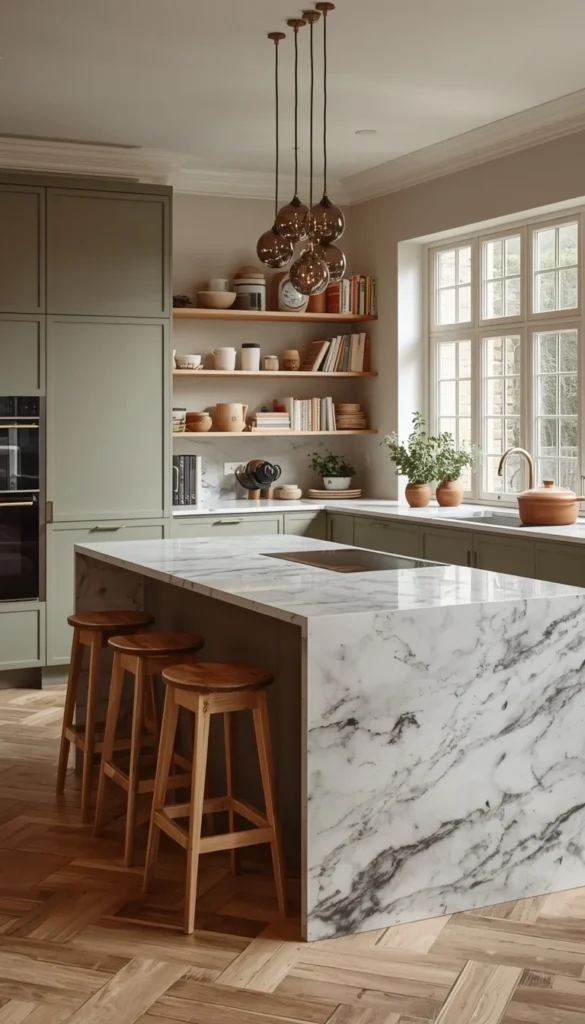
The kitchen is arguably the most important room in the home — it is where nourishment, creativity, connection, and the daily rituals of family life all converge — and creating a kitchen that is as beautiful as it is functional is one of the most rewarding interior design challenges you can take on. The Scandi-luxe kitchen aesthetic, which blends the clean, functional minimalism of Scandinavian design with warm, luxurious material choices, has become enormously influential because it solves the central tension of kitchen design: the need for a hard-working, practical space that also feels beautiful enough to want to spend time in. Handleless cabinets in soft dusty sage or warm greige, combined with a dramatic marble or stone island, create a kitchen that feels simultaneously calm, sophisticated, and deeply inviting.
The details that elevate a Scandi-luxe kitchen from nice to extraordinary include hardware choices — unlacquered brass taps and handles that will develop a beautiful patina over time feel infinitely more characterful than standard chrome — and lighting strategy, with pendant lights above the island providing both task lighting and sculptural beauty. Open shelving on one wall breaks the uniformity of closed cabinetry and creates an opportunity to display beautiful everyday objects: stacked hand-thrown ceramics, a row of glass spice jars with ceramic lids, a wooden bread board standing on its edge. A large ceramic or enamel cookpot in a beautiful color sitting on the hob, even when not in use, adds warmth and personality. The Scandi-luxe kitchen is a space where cooking feels less like a chore and more like a genuinely pleasurable creative act.
24. Vertical Gardens & Living Walls
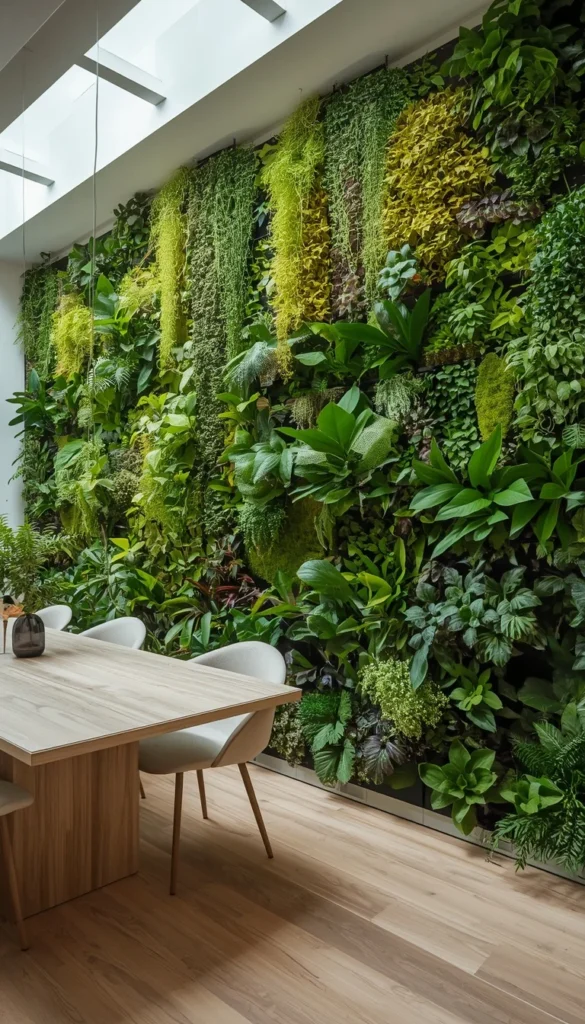
A living plant wall — a floor-to-ceiling installation of plants growing vertically on a structure mounted to the wall — represents perhaps the boldest and most dramatically beautiful expression of biophilic design in the contemporary interior, and it remains one of those interior design ideas that genuinely stops people in their tracks every single time they encounter one. The visual impact of an entire wall covered in living, breathing green — a tapestry of ferns, moss, trailing vines, and small-leaved climbing plants — is extraordinary and unlike any other design element available. Beyond aesthetics, a living wall genuinely improves indoor air quality, regulates humidity, reduces ambient noise, and creates a measurable positive effect on the mood and stress levels of anyone in the room.
Modern living wall systems have become increasingly accessible and manageable for home use — modular panel systems that mount to a standard wall and include integrated irrigation make maintenance far simpler than the hydroponic installations that once required professional installation. Choose plants suited to your light levels: shade-tolerant species like pothos, heart-leaf philodendron, ferns, peace lilies, and moss work well in most interior positions. Water-retaining substrates and self-watering panel systems reduce maintenance to a weekly check. Even a smaller-scale interpretation — a 4 foot by 3 foot panel of preserved moss and air plants that requires no watering whatsoever — can bring the visual drama of a living wall to any room. Place a living wall behind a dining table, at the end of a corridor, or as a bedroom headboard alternative for a room-defining installation of genuine natural magnificence.
25. The Artful Entryway
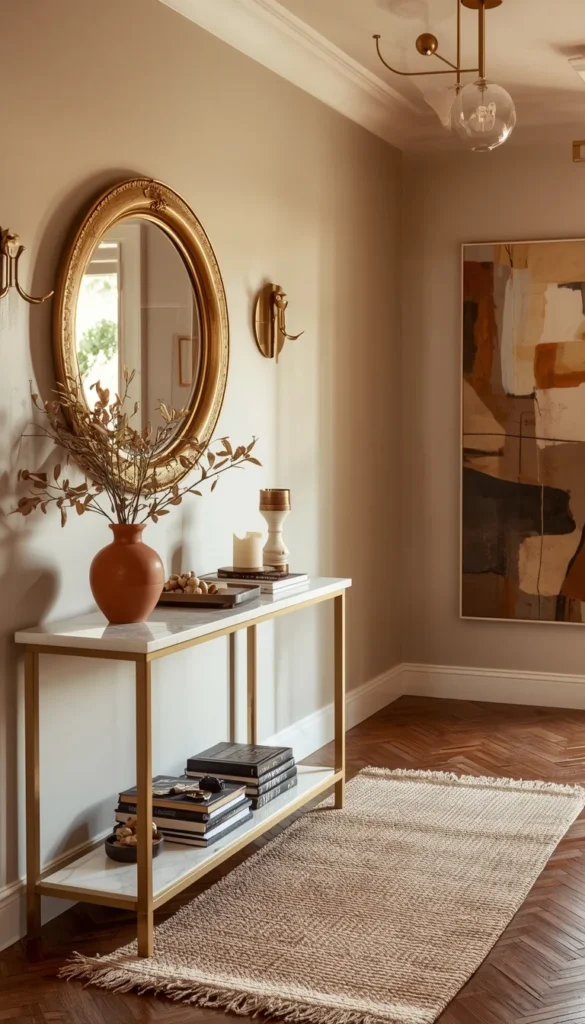
The entryway is the opening sentence of your home’s story — it is the first impression, the setting of tone and atmosphere, the space that tells every visitor what kind of home they are about to enter and how it will make them feel. Yet it is one of the most chronically neglected spaces in most homes, too often treated as merely a functional transition zone rather than a room deserving of as much design attention as any other. A beautifully designed entryway changes the entire experience of arriving home: the moment you cross the threshold into a space that is warm, intentional, beautiful, and welcoming, something in your body literally relaxes. You feel, even before you’ve sat down, that you are somewhere that cares for you.
Creating a stunning entryway requires addressing four elements: a focal point (a beautiful mirror, a bold piece of artwork, or a dramatic lighting fixture that draws the eye immediately upon entering), a surface for placing objects (a slim console table or floating shelf with curated styling), practical storage that doesn’t look practical (hooks styled as sculpture, a beautiful basket for bags, a ceramic pot for umbrellas), and flooring that welcomes and defines (a runner rug in a pattern or texture that sets the room’s personality). In even the smallest hallway, these four elements can be compressed into a tight but beautiful composition. Style the console table with restraint and intention: one large object, one medium object, one small object, and one living element (a plant or fresh flowers). Change the living element regularly and your entryway will always feel fresh, alive, and genuinely wonderful.
✨ Keep scrolling — the next ideas get even better!
26. Scent as the Invisible Interior Element
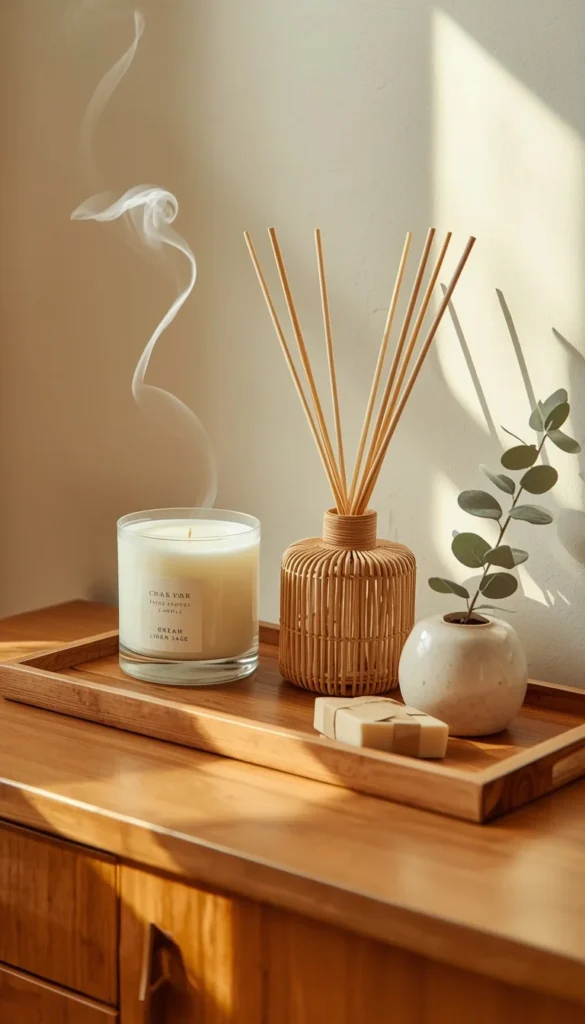
Scent is the most powerful and most overlooked of all the interior design ideas in this guide, because unlike every other element we have discussed, scent bypasses the visual cortex entirely and speaks directly to the limbic system — the most ancient, emotional part of the brain. The scent of a room is felt before it is consciously perceived, and it creates an immediate, deeply personal emotional response that no paint color, piece of furniture, or decorative object can replicate. A home with a beautiful, consistent signature scent feels more complete, more intimate, and more genuinely welcoming than one that relies on visual beauty alone. The most memorable homes in the world all have a scent — and their owners have chosen that scent as deliberately as they chose their wall color.
Creating a beautiful home scent strategy is about layering different scent delivery methods throughout your space: large natural soy or beeswax candles in the living room for evening warmth and ambiance, reed diffusers in hallways and bedrooms for continuous, subtle background fragrance, a linen spray on your pillows and cushions for an intimate textile scent, fresh botanicals (eucalyptus branches, lavender stems, fresh herbs) in the kitchen and bathroom for living green freshness, and incense sticks or a Japanese koh incense ceremony in a dedicated mindfulness corner. Choose fragrance families that harmonize: woody, earthy, botanical tones (sandalwood, cedarwood, vetiver, eucalyptus, lavender, fresh linen) create a cohesive home scent that feels organic and deeply personal. Your home should smell like your best, most beautiful self — and it will make everyone who enters feel, inexplicably and immediately, perfectly at ease.
27. Fluted & Reeded Surfaces
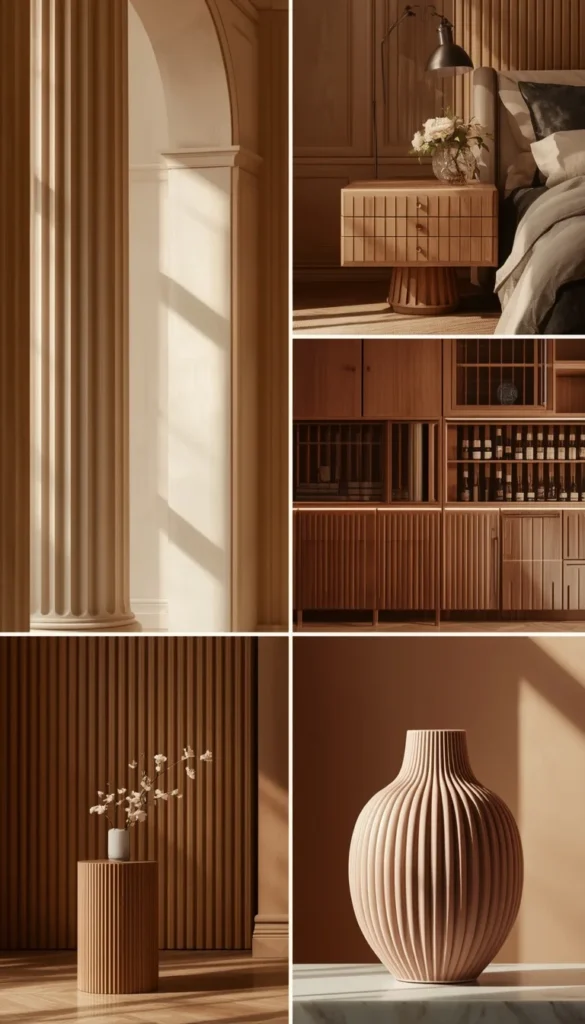
Fluted and reeded surfaces — characterized by their series of parallel vertical ridges that create a pleated, sculptural quality — have emerged as one of the most distinctive and widely loved architectural detail trends in contemporary interior design, and they bring a level of textural sophistication to rooms that feels both classically rooted and entirely of the moment. Originally drawn from ancient Greek and Roman architectural columns, the fluted motif has been reimagined across every surface and material in the contemporary home: plaster columns and wall panels, oak and walnut cabinetry, bedside table and cabinet legs, ceramic vases, brass hardware, glass inserts, and even fabric headboards with vertically quilted channels that create a similar pleated effect. The consistent quality that makes fluting so beautiful is what it does with light — each ridge catches illumination and casts a subtle shadow, creating depth and movement on what would otherwise be a flat surface.
Incorporating fluted details into your home can be as bold or as subtle as you choose. At its most dramatic, floor-to-ceiling fluted plaster panels on a living room wall create an architectural feature of genuine grandeur and museum-quality refinement. At its most accessible, a single fluted ceramic vase on a shelf, a reeded glass cabinet door, or a bedside table with a fluted cylindrical base introduces the motif at an achievable scale. Fluting works across virtually every aesthetic: it brings classical elegance to a maximalist room, adds textural interest to a minimalist one, and provides a grounding architectural quality to bohemian spaces that might otherwise feel too loose and unstructured. It is one of those rare design details that simultaneously looks expensive and handmade — a combination that is genuinely hard to achieve.
28. The Capsule Wardrobe Room
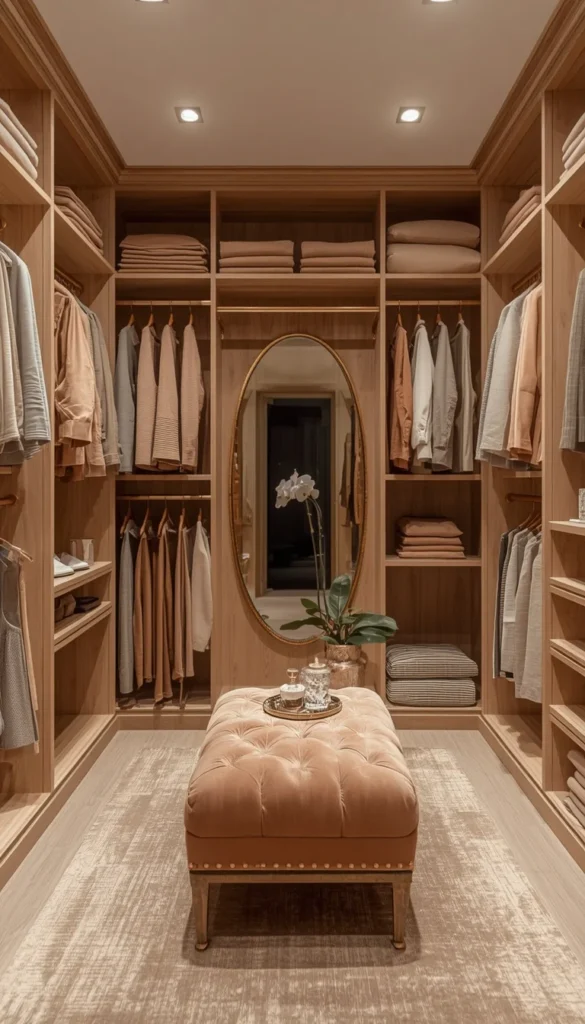
Transforming your bedroom storage into a capsule wardrobe room — or even just reorganizing a large wardrobe into a beautifully curated, boutique-style storage system — is one of those interior design ideas that improves the quality of your daily life in ways that go far beyond aesthetics. The act of editing your wardrobe down to only the pieces you truly love and wear, then organizing them in a way that is visually beautiful and immediately accessible, removes an extraordinary amount of daily decision fatigue and replaces it with a morning ritual that feels genuinely pleasurable. Open shelving in warm oak, organized by color and category, with neatly folded knitwear, hanging garments grouped by length, and a dedicated surface for accessories, transforms getting dressed from a chore into a calm, intentional act of self-expression.
Creating a boutique-style wardrobe room is as much about subtraction as addition. Begin with a thorough edit: remove everything that doesn’t fit, doesn’t suit, or doesn’t make you feel genuinely good. What remains will likely occupy significantly less space and can be organized with much more care and intentionality. Invest in matching wooden or velvet hangers — this single change makes a remarkable visual difference. Use matching containers, baskets, and boxes in a consistent palette for folded items and accessories. Add a full-length mirror — an oval one in an aged gold or natural wood frame is particularly beautiful — and good lighting: warm, even illumination is essential for both functionality and ambiance. A small upholstered stool or bench inside the wardrobe space completes the boutique feeling and makes the daily ritual of dressing a genuinely luxurious experience.
29. The Layered Rug Strategy
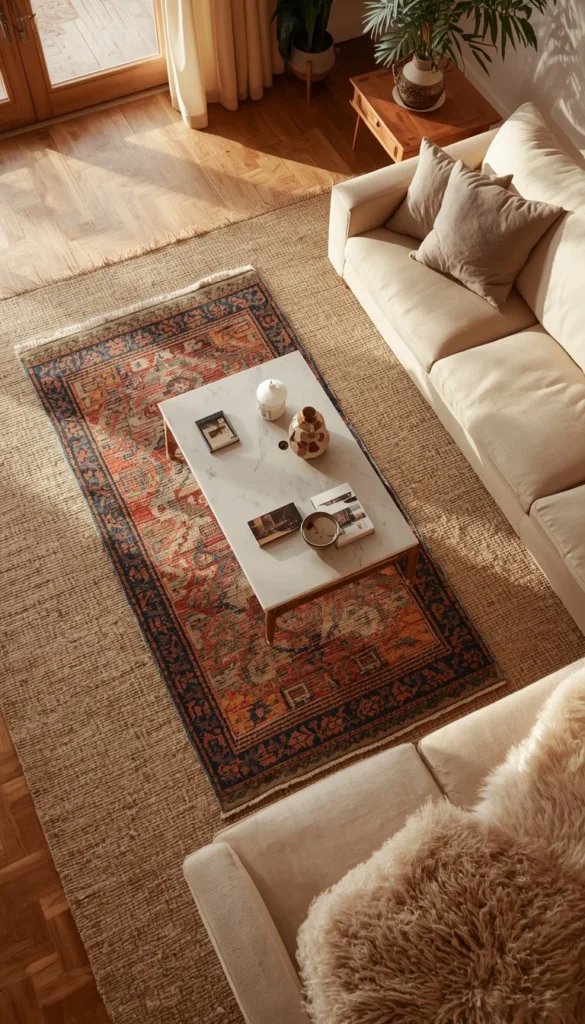
Layering rugs is one of the most creative, affordable, and visually impactful interior design ideas for transforming the feel of a room from flat and ordinary to richly textured and deeply inviting, and it is a technique borrowed directly from the styling playbooks of the world’s best interior designers and most admired design publications. The principle is beautifully simple: start with a large, relatively neutral base rug that covers most of the floor area — a flat-woven jute, sisal, or natural fiber rug works perfectly — and then layer a smaller, more characterful rug on top of it, positioned over the main seating area. This secondary rug can be bolder, more patterned, more textural, or more colorful than the base, because it is contained within the larger neutral field and therefore reads as a carefully chosen accent rather than an overwhelming statement.
The most beautiful layered rug combinations typically work with contrast in both texture and pattern: a flat jute base with a plush wool rug on top, a plain natural fiber base with a vintage Turkish or Persian kilim as the layer, a simple cotton dhurrie base with a chunky hand-knotted wool rug adding depth. The top layer should be sized to sit well within the footprint of the sofa arrangement — generally two-thirds to three-quarters of the base rug’s size — with the base rug visible as a frame around it. A third layer — a small sheepskin or sheepskin-effect rug — can be draped over the arm of a sofa or positioned in front of a reading chair as a tertiary accent that adds softness and warmth at the ground level. The layered rug strategy creates a room that looks genuinely curated, effortlessly collected, and completely irresistible to sink into.
30. The Personal Altar & Mindfulness Corner
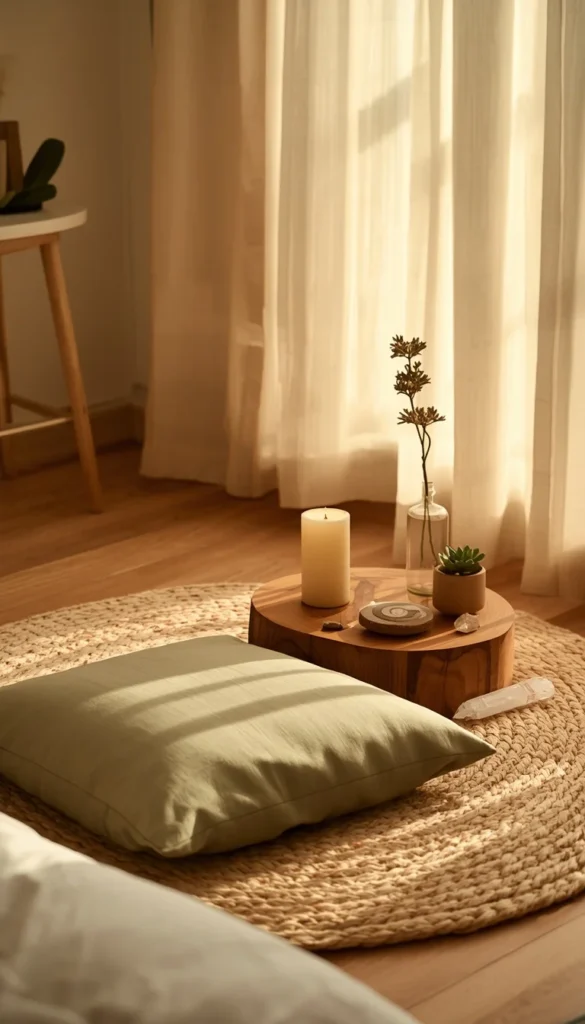
The personal mindfulness corner — a deliberately created, small-scale sanctuary within your home that is dedicated entirely to stillness, reflection, and intentional pause — is perhaps the most meaningful and emotionally resonant of all 30 interior design ideas in this guide. As the pace of modern life continues to accelerate and the demands on our attention intensify, the physical act of creating a designated space for quiet — however small, however humble — sends a powerful message to yourself about what you value and what you need. It doesn’t require an entire room or even a large space: a corner of a bedroom, a window alcove, a spot beside a bookshelf cleared of all clutter — any space of roughly 4 square feet can become a deeply meaningful sanctuary if it is given intention and care.
A beautiful mindfulness corner is built around a few essential elements: something to sit on (a meditation cushion, a yoga bolster, a folded blanket), a surface for meaningful objects (a small wooden tray or low table), and a curated selection of objects that feel personally sacred or symbolically meaningful — a candle, an incense holder, a smooth stone from a meaningful place, a photograph of someone you love, a crystal, a small plant, a journal. Keep the surrounding space absolutely clear — the mindfulness corner works by contrast: it is the quiet island in the room, the place your eye and your body rest go when everything else is too much. Style it with restraint and love, change the elements with the seasons, and return to it daily. A mindfulness corner is not just a beautiful interior design choice — it is a daily act of self-care made permanent and beautiful in your home.
Related posts: 30 Perfect Emerald Green Sofa Living Room Ideas for Small & Large Spaces
Your Dream Home is Waiting
Beautiful interior design is not a luxury reserved for those with unlimited budgets or professional design training — it is a deeply human practice, available to every one of us, of creating spaces that reflect who we are, support how we live, and nourish us every single day. Every one of the 30 interior design ideas in this guide is actionable, achievable, and genuinely transformative in its own way — whether it’s the simple act of layering a new rug, painting a single wall in a warm earthy tone, or carving out a cozy reading nook from a forgotten corner of your bedroom.
The most important thing to remember is that your home is not a showroom — it is a living, breathing expression of your personality, your values, your memories, and your dreams. The most beautiful rooms in the world are not the most perfectly decorated ones; they are the ones that feel most completely and authentically inhabited by the people who live in them. So take the ideas that resonate with you most deeply, make them your own, layer them slowly and lovingly, and allow your home to evolve into the sanctuary it was always meant to be.
Start with one idea this week. Just one. And notice how it changes not just your room, but how you feel inside it. That is the real magic of interior design — it doesn’t just make spaces more beautiful. It makes life feel more beautiful too.